MANUSMRITI
Manusmriti: A Civilizational Framework of Order, Ethics, and Social Balance
Introduction
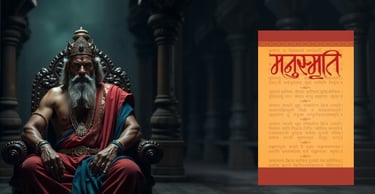
Manusmriti, traditionally attributed to Manu—the archetypal lawgiver of Indian civilization—is one of the earliest known attempts in human history to articulate a comprehensive framework for social order, moral conduct, governance, and spiritual discipline. Rather than viewing Manusmriti through the narrow lens of modern legal absolutism, it is more meaningful to understand it as a civilizational document, reflecting the needs, psychology, and conditions of an ancient society striving for harmony, stability, and ethical continuity.
Like all foundational texts of early civilizations, Manusmriti is not merely a book of laws; it is a mirror of a living culture negotiating duty (dharma), responsibility, and cosmic order (ṛta).
Manusmriti: Clearing Confusion in an Age of Political Misinterpretation
Manusmriti is among the most debated and least understood texts of Indian civilization. In modern times, it has increasingly become a political symbol rather than a subject of serious study. Selective quotations, removed from historical, linguistic, and cultural context, are frequently used by politicians and ideological movements to create fear, resentment, or polarization. As a result, a complex civilizational text is reduced to slogans, and scholarship is replaced by propaganda.
One major source of confusion lies in treating Manusmriti as a rigid, eternal lawbook comparable to a modern constitution. In reality, it belongs to the Dharmashastra tradition, where law, ethics, custom, and spiritual discipline are intertwined. Manusmriti itself acknowledges the authority of local practices, changing circumstances, and moral reasoning. It was never imposed uniformly across India, nor was it considered infallible or beyond debate.
Another form of misguidance arises from reading isolated verses without understanding Sanskrit grammar, commentarial traditions, or historical context. Ancient societies framed social responsibility differently due to the absence of modern institutions such as courts, welfare systems, and policing. When these frameworks are judged solely through modern political ideology, misunderstanding is inevitable.
Modern socialist and political narratives often project contemporary power struggles onto ancient texts, turning Manusmriti into a convenient scapegoat for historical injustices without examining how Indian society actually evolved through reform, interpretation, and plural traditions. This approach discourages learning and replaces inquiry with outrage.
Our online course on Manusmriti is designed to move beyond propaganda—both in praise and in condemnation. It offers structured, contextual, and critical study using original Sanskrit verses, traditional commentaries, and rational analysis. The aim is not blind acceptance, but informed understanding. Only through education, not distortion, can confusion be removed and intellectual honesty restored.

Historical Context: Law Before the Modern State
Manusmriti emerged in a time when there was no centralized state machinery, no written constitutions, and no enforcement agencies as understood today. Social stability depended on shared moral norms, self-discipline, and role-based responsibility rather than coercive authority.
In this context, Manusmriti served as:
A moral compass for individuals
A guide for rulers
A social contract rooted in duty rather than rights
A bridge between spiritual ideals and everyday life
It was never intended as a rigid, unchanging statute book but as a normative guide, adaptable to time, place, and circumstance—a fact clearly acknowledged in the broader Dharmashastra tradition.
Dharma as the Core Principle
At the heart of Manusmriti lies the concept of Dharma, which is not equivalent to law in the modern sense. Dharma is:
Ethical responsibility
Social duty
Spiritual alignment
Harmony with cosmic order
Rather than promoting blind obedience, Manusmriti repeatedly emphasizes:
Self-control over punishment
Inner discipline over external enforcement
Moral intent over mechanical rule-following
This approach reflects a deep psychological insight: societies endure not through fear alone, but through shared values internalized by individuals.
Social Organization: Stability Over Chaos
Manusmriti’s social classifications are often misunderstood when viewed outside their historical framework. In ancient times, social organization was largely functional, not ideological. Professions, skills, and responsibilities were distributed to ensure social continuity and economic survival.
From a positive perspective:
It aimed to prevent social anarchy
It stressed interdependence among social roles
It imposed duties on all groups, including rulers and elites
Authority was always tied to responsibility and restraint
Importantly, Manusmriti places high ethical expectations on those in power, particularly kings, judges, and teachers, insisting that moral failure among elites leads to societal decay.
Political Thought: Accountability of Power
Manusmriti contains sophisticated reflections on governance:
The king is described as a trustee, not an owner, of power
Rulers are warned that injustice leads to collapse
Law is placed above the ruler, not beneath him
Protection of the weak is presented as the primary duty of the state
These ideas anticipate modern concepts of limited authority, ethical governance, and rule-bound leadership, centuries before such notions appeared in Western political philosophy
Spiritual Humanism: Inner Discipline as Social Strength
Unlike purely legal texts, Manusmriti integrates spiritual discipline with social ethics. It recognizes:
Desire as a destabilizing force if unchecked
Self-restraint as a form of freedom
Knowledge and wisdom as higher than birth or wealth
Renunciation as a valid and honored life choice
The four-stage life model (āśrama system) encourages balance:
Learning in youth
Responsibility in adulthood
Gradual withdrawal from material obsession
Final pursuit of liberation (mokṣa)
This model reflects a profound understanding of human psychological evolution.
Women and Family Life: Protection Within Context
While modern debates often focus on selected verses, Manusmriti also emphasizes:
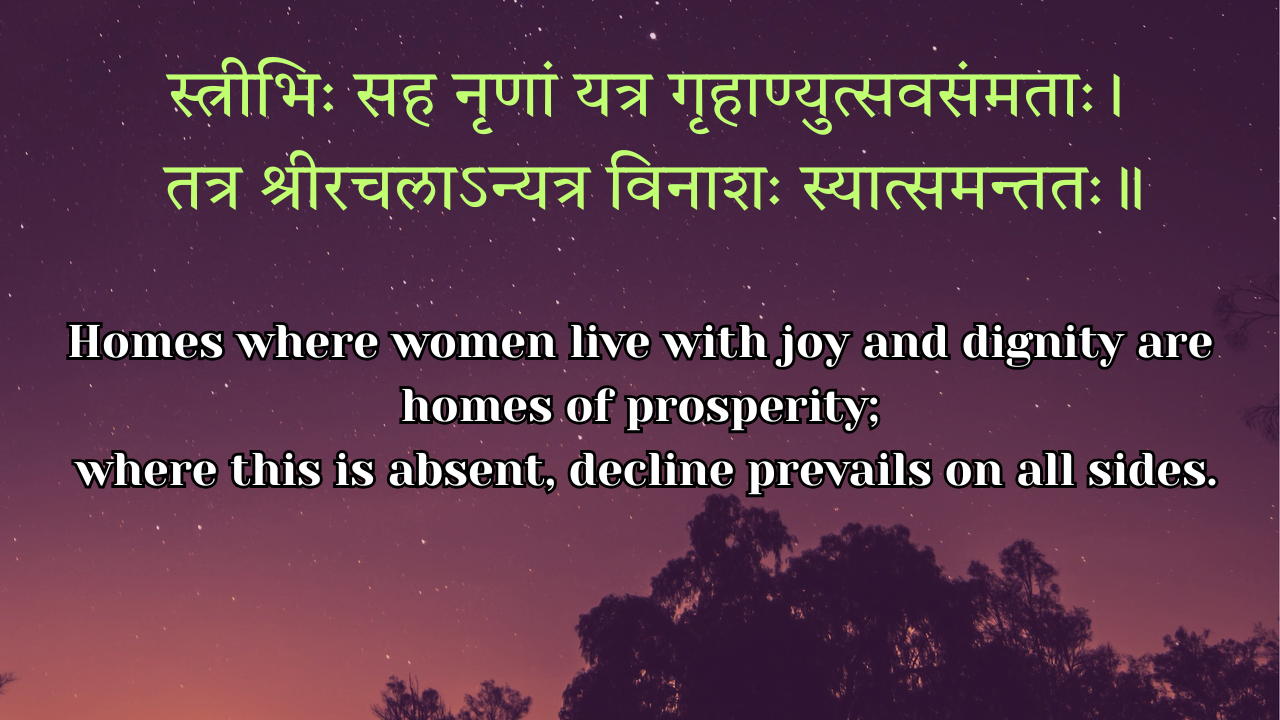
Respect for women as central to family and social stability
The idea that societies flourish where women are honored
Strong condemnation of exploitation and abuse
In ancient societies without institutional safety nets, protection was framed in paternal and familial terms rather than individualistic autonomy. While these frameworks require reinterpretation today, their original intent was social security, not dehumanization.
Manusmriti as a Living Tradition, Not a Frozen Text
Indian civilization never treated Manusmriti as a single, final authority. It coexisted with:
Local customs (ācāra)
Regional practices
Other Dharmashastras
Philosophical traditions that openly debated and revised norms
This plurality prevented dogmatism and allowed society to evolve organically.
Modern Relevance: Learning Without Literalism
The true value of Manusmriti today lies not in literal enforcement, but in:
Its emphasis on duty alongside rights
Ethical restraint in power structures
Moral accountability beyond legal compliance
The integration of spirituality with public life
When read thoughtfully, Manusmriti invites reflection on how civilizations seek order without losing meaning, and discipline without losing humanity.
Conclusion
Manusmriti should neither be blindly glorified nor casually dismissed. It is a civilizational artifact—a sincere attempt by an ancient society to align law, morality, and spirituality into a coherent whole.
Its enduring contribution lies in its vision of a society governed not merely by force or fear, but by inner discipline, ethical responsibility, and reverence for cosmic order. Engaging with Manusmriti critically yet respectfully allows modern readers to understand not just the past, but the perennial human quest for balance between freedom and order.
Online course on Manusmriti: Clearing Confusion in an Age of Political Misinterpretation
Manusmriti is among the most debated and least understood texts of Indian civilization. In modern times, it has increasingly become a political symbol rather than a subject of serious study. Selective quotations, removed from historical, linguistic, and cultural context, are frequently used by politicians and ideological movements to create fear, resentment, or polarization. As a result, a complex civilizational text is reduced to slogans, and scholarship is replaced by propaganda.
One major source of confusion lies in treating Manusmriti as a rigid, eternal lawbook comparable to a modern constitution. In reality, it belongs to the Dharmashastra tradition, where law, ethics, custom, and spiritual discipline are intertwined. Manusmriti itself acknowledges the authority of local practices, changing circumstances, and moral reasoning. It was never imposed uniformly across India, nor was it considered infallible or beyond debate.
Another form of misguidance arises from reading isolated verses without understanding Sanskrit grammar, commentarial traditions, or historical context. Ancient societies framed social responsibility differently due to the absence of modern institutions such as courts, welfare systems, and policing. When these frameworks are judged solely through modern political ideology, misunderstanding is inevitable.
Modern socialist and political narratives often project contemporary power struggles onto ancient texts, turning Manusmriti into a convenient scapegoat for historical injustices without examining how Indian society actually evolved through reform, interpretation, and plural traditions. This approach discourages learning and replaces inquiry with outrage.
Our online course on Manusmriti is designed to move beyond propaganda—both in praise and in condemnation. It offers structured, contextual, and critical study using original Sanskrit verses, traditional commentaries, and rational analysis. The aim is not blind acceptance, but informed understanding. Only through education, not distortion, can confusion be removed and intellectual honesty restored.